
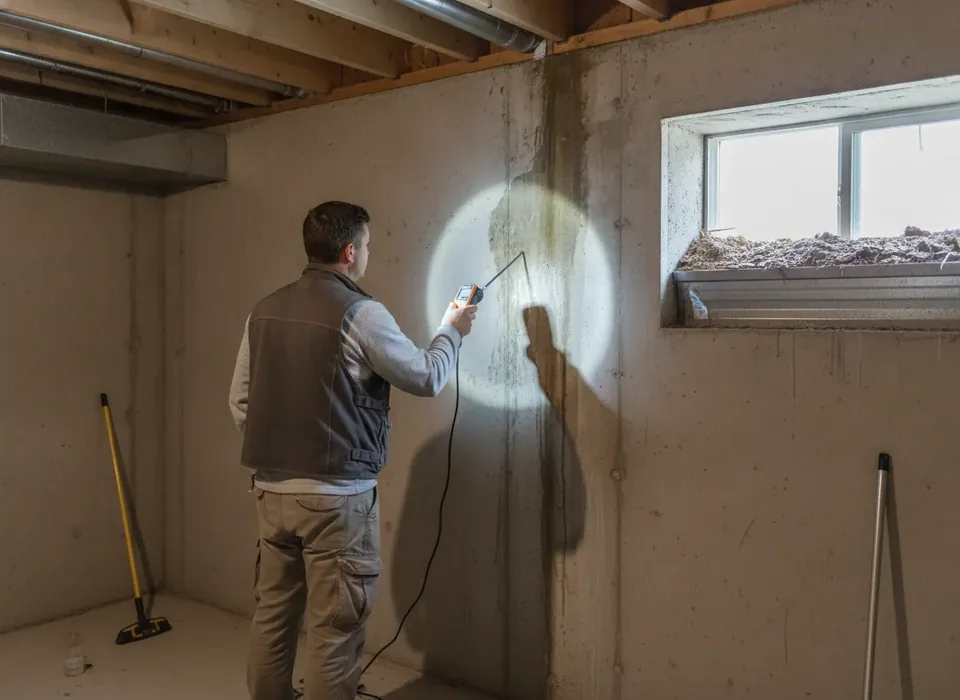
Every spring, a predictable set of calls starts in the Pikes Peak region: a musty smell in the basement, a damp carpet corner, a stain creeping up the drywall behind the furnace. The trigger is usually snowmelt. March is the snowiest month in Colorado Springs at an average of 5.7 inches, April adds 5.5, and spring snow is wet and heavy. Under a strong sun at 6,000 feet, a foot of it can turn into saturated ground against your foundation in a day or two.
Roughly a third of homes in the city have basements, per industry estimates, and crawl spaces are common in the rest. Both sit below grade, where water goes when it has nowhere else to go. This guide explains how it gets in, what to check, and when the cleanup is a job for the companies on basement and crawl space mold.
How snowmelt reaches a basement
Expansive clay soils
Much of El Paso County sits on expansive clay. Local inspectors routinely point to bentonite-rich soil that swells when wet and shrinks when dry, which over years cracks foundation walls, basement slabs and the joint between them. When snowmelt saturates swollen clay, hydrostatic pressure pushes water through those cracks and through the cold joint at the floor. The telltale sign is a damp line along the base of the wall or a wet strip where the slab meets the footing.
Window wells
Egress window wells are the most common entry point local companies describe. Snow piles against the house, melts into the well, and if the drain at the bottom is clogged with leaves or was never connected, the well fills like a bucket and water comes in over or around the window frame. Look for staining on the wall below the window and swelling in the drywall return.
Grading and downspouts
Soil settles toward a house over time. A yard that slopes toward the foundation, a downspout that dumps at the corner, or a disconnected extension sends every inch of melt straight down the wall. The fix is often cheap; the mold it caused is not.
Sump pumps and drain tile
Homes with a perimeter drain and sump pit depend on the pump. A pump that failed quietly over winter, a float stuck under a discharge hose, or a frozen discharge line means the pit overflows the first week of melt.
Sewer backups are a different problem. Saturated ground and heavy runoff can also overload sewer lines. Colorado Springs Utilities' policy covers damage from verified blockages in its main line when the customer was not negligent; the service line from your house to the main, and any backup it causes, is the homeowner's responsibility, and acts of nature such as severe storms are excluded. Sewage is Category 3 water. Do not clean it yourself, and check whether your policy has a sewer backup endorsement, since standard policies usually leave it out.
What to check this week
- Walk the basement with a flashlight at floor level. Look for a dark line along the base of walls, lifted or cupped flooring, and rust on metal furniture legs or the furnace base.
- Press on the lower 12 inches of drywall. Soft or crumbling paper means it was wet long enough to matter.
- Open every window well and clear the drain. Pull snow at least a few feet back from the house.
- Check the sump pit and run the pump by lifting the float.
- Smell the carpet in corners and along exterior walls. Pad holds water for weeks after the surface feels dry.
- In a crawl space, look at the underside of the subfloor and the top of the foundation wall for white or dark fuzz and for dripping insulation.
When it is more than a wet spot
EPA's guideline is that a patch under about 10 square feet can be a homeowner cleanup on hard surfaces. Finished basements rarely qualify, because the wet material is drywall, carpet pad and framing, all porous, and the growth is usually behind the finish where you cannot see its true size. If the carpet was wet for more than a day or two, if drywall is stained above the baseboard, or if the smell persists after drying, get quotes.
What the companies typically do: map moisture with meters to find the real extent, set containment and negative air, remove wet drywall and pad (a flood cut 12 to 24 inches up the wall is common), HEPA vacuum and clean framing, dry the space with air movers and dehumidifiers, then confirm with a visual check and optional clearance testing. Rebuild comes after. The process page walks through each step.
What it costs
| Item | Typical published range | Source |
|---|---|---|
| Basement remediation | $1,500–$4,000 | Fixr 2025 |
| Crawl space remediation | $500–$2,000 | Fixr 2025 |
| Per sq ft of affected area | $10–$25 | This Old House 2026 |
| Inspection / testing (separate) | $303–$1,044 | HomeAdvisor 2025 |
These are national published ranges, not quotes. Local numbers come from the companies. Grading, window well drains, foundation crack injection and sump work are separate trades and separate bills. The cost guide has the full table and a planning calculator.
Older homes: two extra questions
About 39% of Colorado Springs homes were built before 1980. If the basement finish is original, ask whether an asbestos test is needed before tear-out. Colorado's rules apply at 32 square feet of suspect material in a home, and textured drywall, joint compound and old sheet flooring are common suspects. For pre-1978 homes, paid work that disturbs painted surfaces falls under EPA's lead renovation rule. Neither is a reason to delay drying; both are reasons to ask before demolition starts.
One related note: the same foundation cracks and slab joints that admit water also admit radon, and El Paso County is an EPA Zone 1 county, but radon mitigation is a separate trade from mold remediation.
Insurance and the question of "sudden"
Seepage through a foundation is the textbook example of what homeowners policies exclude: it is gradual, it comes from groundwater, and it is treated as maintenance. A sump pump failure may be covered if you carry a water backup endorsement. Document the damage with photos before anyone removes material, check your mold sublimit, and ask the adjuster rather than assuming. Does homeowners insurance cover mold in Colorado goes into the exclusions.
Preventing the repeat next March
Most spring basement mold comes back unless the water path changes. Extend downspouts at least four to six feet, regrade so soil slopes away from the house, install or clear window well covers and drains, test the sump pump each fall and add a battery backup, and keep snow shoveled away from the foundation on the sunny side where melt is fastest. If water still comes through the wall, a foundation contractor can look at crack injection or exterior drainage. Then, if you are selling, remember that Colorado sellers must disclose known moisture or water problems in a basement or crawl space on the state disclosure form, and known mold is a material fact.
Frequently asked questions
Why does my basement only get wet in spring?
Spring snow in Colorado Springs is wet and heavy, March and April are the snowiest months, and a strong high-altitude sun melts it fast. Saturated clay soil pushes water through foundation cracks, slab joints and window wells. The rest of the year, the soil is usually dry enough that the same cracks stay dry.
Can I just dry the carpet and leave it?
If it was wet for more than a day or two, the pad under it and the drywall behind the baseboard are usually wet too, and both are porous. Companies commonly remove the pad and the lower section of drywall rather than try to dry them in place. Drying alone is reasonable only for a small, quick spill on a hard surface.
Is basement seepage covered by insurance?
Usually not. Groundwater seepage is gradual and excluded under most policies. A sudden event such as a sump pump failure may be covered with a water backup endorsement, and mold is often subject to a sublimit. Check your policy and document everything before cleanup.
Do I need an asbestos test before the company removes basement drywall?
Ask. In homes built before about 1989, and especially before 1980, drywall texture, joint compound and old flooring can contain asbestos, and Colorado's rules apply at 32 square feet of suspect material in a single-family home. An asbestos building inspector holding CDPHE certification takes the samples; the remediation company can tell you whether your job reaches that threshold.
Ready for numbers from local companies? Request free quotes or call Call (719) 642-1761. Colorado Springs Mold Pros is a free quote service, not a mold company; independent local companies reply to you directly.