
Mold Removal & Remediation in Colorado Springs, CO
Describe the problem once and independent local mold remediation companies reply with free quotes. This page explains what a proper job includes, what it usually costs along the Front Range, and what to ask before you sign anything.
Get a Free Quote Call (719) 642-1761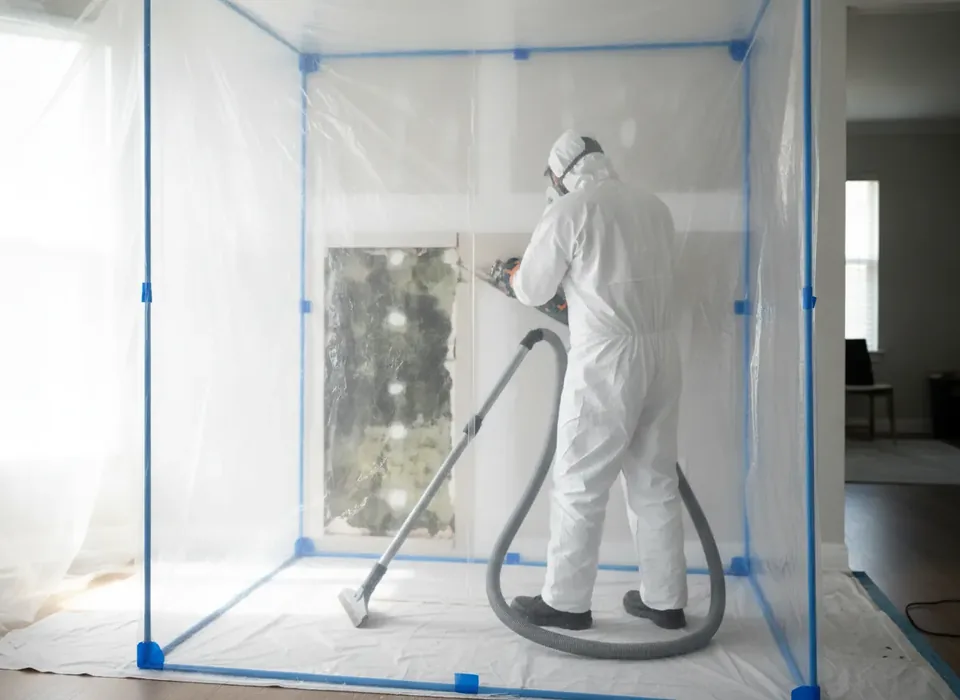
What is going on behind that stain
Mold needs spores, food and water. The first two are everywhere, in drywall paper, wood and dust. Water is the one you control. Colorado Springs air is dry most of the year, with afternoon humidity near 40 percent, so mold here almost always traces back to one wet spot: a slow leak, a damp foundation wall, a roof breach after hail, a condensing window, or a swamp cooler left wet.
Scrubbing the stain is the easy part. The companies we connect you with are judged on whether they find the water, keep spores from spreading while they work, and prove the materials are dry before the wall is closed back up.
Not sure what you are looking at? Start with a mold inspection.
What a mold remediation company actually does
Inspection and moisture mapping
A tech meters the walls, marks how far the wet area extends, and traces the source. On older homes they should flag materials that may need an asbestos test before anything is cut.
Containment and negative air
The work area is sealed with plastic sheeting and a zipper door. A HEPA air scrubber keeps dust and spores inside the containment instead of drifting into bedrooms and the furnace return.
Removal
Porous materials with growth, such as drywall, insulation, carpet pad and particleboard, are cut out and bagged inside the containment. Framing and concrete are usually cleaned, HEPA vacuumed and sometimes sanded rather than replaced.
Drying
Air movers and a dehumidifier run until meter readings on the framing and subfloor hit a dry standard. This step often sets the schedule.
Clearance
A visual check at minimum: no visible growth, no musty odor, dry readings. Some homeowners add sampling by a separate inspector before rebuild.
Rebuild
New drywall, trim, paint and flooring. If framing, plumbing or electrical changes, a PPRBD-registered contractor pulls the permit. Details on the process page.
Why Colorado Springs gets mold in a dry climate
Colorado Springs averages about 15.9 inches of precipitation a year, and roughly 65 percent of it falls from May through August in short, hard thunderstorms that overwhelm window wells, foundation drains and hail-cracked shingles. Winter adds frozen pipes during cold snaps like February 2021 and January 2024, ice dams at the eaves, and condensation from furnace humidifiers. Roughly a third of homes have basements, per industry estimates, and many older neighborhoods still cool with swamp coolers. The common thread: the wet spot is hidden, so the mold grows for months before anyone smells it.
Where the mold is changes the job: basement and crawl space, burst pipe or flood, attic, roof leak and ice dam, bathroom and window condensation, HVAC, duct and swamp cooler or black mold.
What mold removal costs
Size, how much material comes out, containment, drying time and rebuild drive the number. Testing is usually a separate line.
| Item | Typical range | Source |
|---|---|---|
| Mold remediation, per sq ft | $10–$25 (avg ≈ $18) | This Old House 2026; Fixr 2025 ($10–$30) |
| Typical whole job | $1,500–$9,000 (national avg ≈ $3,500) | Fixr 2025 |
| Small area ≈ 50 / 100 / 200 sq ft | $500–$1,250 / $1,000–$2,500 / $2,000–$5,000 | This Old House 2026 |
| Whole house | $10,000–$30,000 | Fixr 2025 |
| Colorado Springs per sq ft (dated) | $9–$19 | HomeBlue, Mar 2022 — dated |
Typical published ranges, not quotes (Fixr Aug 2025, This Old House Mar 2026, HomeAdvisor 2025). Colorado Springs quotes come from the companies, not from this site.
Room-by-room ranges and a square-foot estimator are on the mold remediation cost guide. Get at least two written quotes; the spread between companies is often wider than the national range suggests.
Insurance, asbestos and permits
Insurance. Homeowners policies generally cover mold only when it follows a sudden, covered event such as a burst pipe or a failed water heater. Slow leaks, seepage, neglect and flooding are usually excluded, and mold sublimits of $1,000 to $10,000 are common. Read your sublimit, photograph everything before cleanup, and do not assume a claim will pay.
Asbestos. About 39 percent of Colorado Springs homes were built before 1980. A mold tear-out easily exceeds the 32 square foot residential trigger level in Colorado's asbestos regulation, and drywall texture, joint compound, linoleum and ceiling tile are all suspect materials. In a pre-1989 home, ask whether an asbestos test is needed before tear-out; sampling is done by an asbestos building inspector holding Colorado state certification, and abatement, if required, by a state-accredited abatement contractor with a 10 working day notice. More in the asbestos-before-tear-out guide. Pre-1978 homes add lead-paint rules for paid work that disturbs paint.
Permits. Cleaning and removing finishes usually needs no PPRBD permit. Rebuilding framing, moving plumbing or electrical, or structural demolition does. Confirm with PPRBD; the company pulling it must be PPRBD-registered.
When it is urgent
- Water is still coming in. Shut the main, cut power to wet circuits if it is safe, and get a plumber or roofer moving first.
- The water was sewage, groundwater or floodwater (Category 3), or growth covers more than about 10 square feet.
- Someone in the home has asthma, a weak immune system or new breathing symptoms. See a doctor.
- You rent. Colorado law gives your landlord 72 hours after written notice to contain the area, stop the water and run HEPA filtration. See tenant mold rights in Colorado.
Questions to ask every company
- What training do your techs hold (IICRC S520, ACAC), and can you send proof of general liability insurance?
- What is the moisture source, and who fixes it?
- Will the written scope name containment and a HEPA air scrubber?
- Does this home need an asbestos test before tear-out?
- How will you confirm the materials are dry, and is a clearance test included?
Get mold removal quotes in Colorado Springs
Tell us where the mold is, roughly how big the area is and what got wet. We pass it to independent local remediation companies, and they reply with quotes.
Independent local companies reply to you directly. No obligation, and you decide who to hire. Prefer to talk? Call (719) 642-1761
Mold removal questions
What is the difference between mold removal and mold remediation in Colorado Springs?
Most companies use the words interchangeably. Remediation describes the whole job: finding and stopping the moisture, containing the area, removing materials that cannot be saved, cleaning and drying what can, and checking the result. Removal is one step inside that. When you compare quotes, look for all of those steps in writing rather than the label on the invoice.
Can I clean up the mold myself?
The EPA says a homeowner can usually handle a patch smaller than about 10 square feet, roughly a 3 by 3 foot area, with gloves, eye protection and an N95. Growth inside walls, in a crawl space or attic, in ducts, after sewage or flooding, or in a home where someone has breathing problems is a reason to get quotes instead. Ask a doctor about symptoms.
Does Colorado license mold remediation companies?
No. Colorado has no state mold license, so nobody can honestly advertise one. Pikes Peak Regional Building Department registrations cover building trades, not mold. What you can check: training such as IICRC S520 or ACAC, proof of general liability insurance, references, and a written protocol. The companies that reply through this site are independent, and we do not verify their credentials. General information, not legal advice.
How long does mold removal take?
A contained bathroom or closet job is often a day or two. A finished basement with wet drywall, carpet and framing can take a week once drying time is counted, and rebuilding the finishes adds more. The company's written scope should include the drying target and how it will be confirmed, because drying is usually what sets the schedule, not the cleaning.
Will the mold come back after remediation?
It can if the water does. The EPA puts it plainly: clean up the mold but leave the water problem and the mold will most likely return. A good quote names the moisture source, such as a cracked window well, a failed supply line or a bath fan dumping into the attic, and says who fixes it. Keeping indoor humidity between 30 and 50 percent helps afterward.
Seeing or smelling mold? Get a clear plan.
Free, no-pressure quotes from independent companies across Colorado Springs, Monument, Fountain, Woodland Park and the Pikes Peak region.