
The honest answer is that nobody can price a mold job from a search result. Size, material, access and whether the water is still coming in change the number by thousands. What this guide can do is show you the published ranges, explain what pushes a quote up or down, and give you the questions that separate a careful quote from a vague one. For the full table, planning calculator and insurance notes, see the Colorado Springs mold remediation cost page.
How quotes work here. Colorado Springs Mold Pros is a free quote service. The figures below are national published ranges, not our prices. Independent local companies look at your home and send their own numbers; compare at least two.
Published price ranges for mold remediation
Typical published ranges, not quotes (Fixr Aug 2025, This Old House Mar 2026, HomeAdvisor 2025). Colorado Springs quotes come from the companies, not from this site.
| Item | Typical range | Source |
|---|---|---|
| Mold remediation, per sq ft | $10–$25 (avg ≈ $18) | This Old House 2026; Fixr 2025 ($10–$30) |
| Typical whole job | $1,500–$9,000 (national avg ≈ $3,500) | Fixr 2025 |
| Small area ≈ 50 sq ft / 100 sq ft / 200 sq ft | $500–$1,250 / $1,000–$2,500 / $2,000–$5,000 | This Old House 2026 |
| Bathroom | $500–$1,500 | Fixr 2025 |
| Basement | $1,500–$4,000 | Fixr 2025 |
| Crawl space | $500–$2,000 | Fixr 2025 |
| Attic | $1,000–$4,000 | This Old House 2026 |
| HVAC / ducts | $3,000–$10,000 | Fixr 2025 |
| Whole house | $10,000–$30,000 | Fixr 2025 |
| Mold inspection / testing (separate) | $303–$1,044 (avg ≈ $670); air-sample lab fees $250–$350 | HomeAdvisor 2025 |
| Colorado Springs per sq ft (dated) | $9–$19 | HomeBlue, Mar 2022 — label as dated |
Two things stand out. First, the per-square-foot figure only describes the mold-affected area, not the room. A 100 sq ft patch behind a basement wall lands in the $1,000–$2,500 band even if the basement is 900 sq ft. Second, the one local figure is from March 2022 and sits a little below the 2025 and 2026 national ranges. Treat it as a floor, not a current price.
What drives the cost up or down
1. Size of the affected area
This is the biggest lever. EPA's rule of thumb is that areas under about 10 square feet are often a do-it-yourself cleanup; above that, most homeowners bring in a company. Companies price in square feet of material to be removed or cleaned, plus the setup around it.
2. Material
Hard, non-porous surfaces such as tile, metal and sealed concrete can usually be cleaned. Porous materials that stayed wet, including drywall, carpet pad, insulation and particleboard, usually get removed and replaced. Removal costs more than cleaning, and replacement is a separate rebuild cost.
3. Containment and negative air
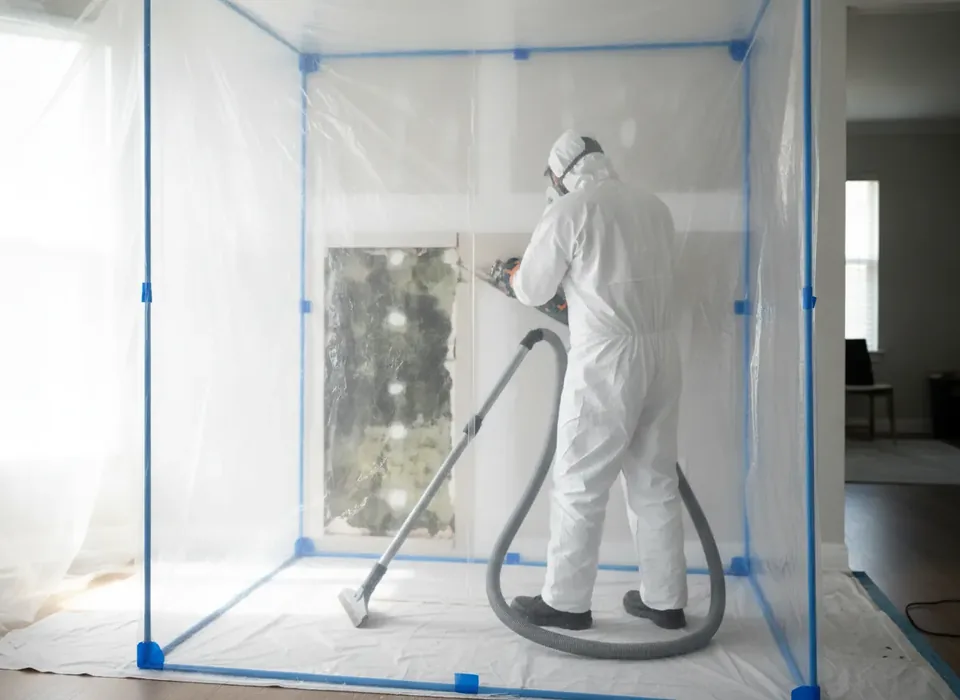
A proper job seals the work area with plastic sheeting and runs an air scrubber under negative pressure so spores do not spread through the house. That equipment, plus the labor to set it up and take it down, is a fixed cost that makes small jobs feel expensive per square foot.
4. HEPA cleaning and drying
After removal, surfaces are HEPA vacuumed and wiped, and the area is dried with air movers and dehumidifiers. Drying time depends on how wet the framing got; a basement that took snowmelt for weeks dries slower than a bathroom with a fixed drip.
5. Asbestos and lead testing
Roughly 39% of Colorado Springs homes were built before 1980. In those homes, ask whether an asbestos test is needed before tear-out: Colorado's rules kick in at 32 square feet of suspect material in a single-family home, and drywall texture, joint compound and old flooring are common suspects. Paid work that disturbs paint in a pre-1978 home falls under EPA's lead renovation rule. Both are extra line items, handled by separate trades, and neither is included in the ranges above. Our asbestos guide covers the details.
6. Rebuild
Remediation ends when the area passes clearance. Putting the drywall, trim, flooring and paint back is construction, often done by a different company. Rebuild that touches framing, plumbing or electrical needs a PPRBD permit pulled by a PPRBD-registered contractor; confirm with PPRBD for your job.
7. Access and cause
A crawl space with 18 inches of clearance, a finished basement with built-ins, or an attic with blown insulation all take longer. And if the water source is not fixed first, the quote may include the plumber or roofer, or exclude it and note that the fix is yours to arrange.
Inspection and testing are priced separately
A mold inspection with air or surface samples runs $303–$1,044 nationally, with lab fees of roughly $250–$350 on top for air samples. EPA notes that when mold is visible, sampling is usually unnecessary, so many homeowners skip testing and go straight to quotes. Where testing earns its fee is when you cannot see the source, when a landlord or buyer needs documentation, or for post-remediation clearance. The mold inspection and testing page explains when it helps and why some people prefer an inspector who is not also bidding the remediation.
Will insurance cover it?
Usually only when the mold follows a sudden covered event, such as a burst pipe or a failed water heater. Slow leaks, long-term seepage and flooding are commonly excluded, and many policies cap mold at a sublimit between $1,000 and $10,000. Check your sublimit, photograph everything before cleanup, and do not count on a payout until the adjuster confirms it. More in does homeowners insurance cover mold in Colorado.
How to compare the quotes you receive
- Ask for a written scope: square footage, materials to be removed, containment plan, equipment, drying days and what clearance looks like.
- Ask whether the price includes the water-source repair, rebuild, and asbestos or lead testing, or excludes them.
- Ask about training (IICRC S520 or ACAC, for example) and general liability insurance. Colorado has no state mold license, so these are the credentials that exist.
- Be wary of a quote that promises to remove every spore. Mold spores are everywhere; the goal is to remove growth and fix moisture.
- Two or three quotes on the same written scope tell you far more than one.
For the service itself, start with mold removal and remediation in Colorado Springs.
Frequently asked questions
What does mold remediation cost per square foot in Colorado Springs?
National published ranges run $10–$25 per square foot of affected area (This Old House, March 2026), with Fixr listing $10–$30. The only Colorado Springs-specific figure found, $9–$19 per square foot, is from HomeBlue in March 2022 and should be treated as dated. Local quotes come from the companies, not from this site.
Why is a small mold job still $1,000 or more?
Containment, negative air, HEPA equipment and the labor to set up and tear down are fixed costs that apply even to a 50 square foot area. That is why small jobs often land in the $500–$1,250 range and 100 square feet in the $1,000–$2,500 range.
Does the price include putting the wall back?
Usually not. Remediation ends at clearance. Rebuilding drywall, trim and flooring is a separate construction cost, and work that touches framing, plumbing or electrical needs a PPRBD permit. Ask each company whether rebuild is included or quoted separately.
Is a mold inspection extra?
Yes. Inspection and testing are priced separately, typically $303–$1,044 nationally with lab fees of $250–$350 for air samples. When mold is visible, EPA notes sampling is usually unnecessary, so many homeowners go straight to remediation quotes.
Ready for numbers from local companies? Request free quotes or call Call (719) 642-1761. Colorado Springs Mold Pros is a free quote service, not a mold company; independent local companies reply to you directly.